How the BDI works
How collaboration works with the BDI
The BDI enables organisations to collaborate digitally without giving up their independence. To make this possible, participants agree on how to share data, identify one another, manage access and ensure they can trust the information being exchanged. Technology supports these agreements, but collaboration remains at the heart of the approach.
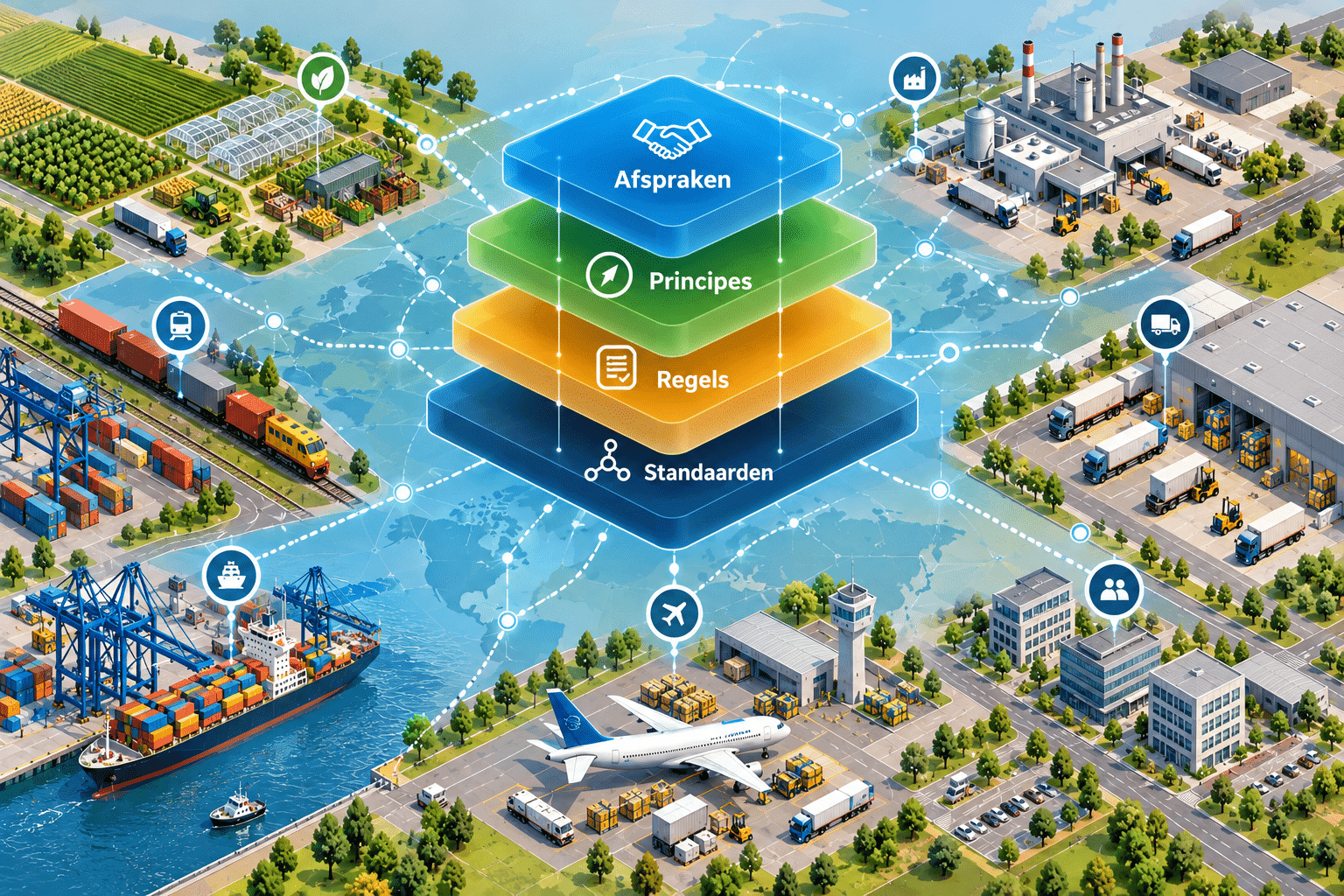
The governance framework as foundation
The BDI is built on a governance framework that defines the shared principles, rules and standards organisations follow when sharing data with one another.
These agreements enable different organisations and systems to collaborate in a consistent way. No single central authority decides who gets access to which data. Instead, organisations retain control and determine who can access their data within the agreed framework.
Seven core principles of the BDI
Connekt physical to digital
The BDI is used for the ‘live’ exchange of data regarding daily processes.
Event-driven architecture
If anything changes relating to a transport route or stock, or if an order is added, a message is sent out immediately.
Zero trust
To improve mutual trust, each party registers with local subnetworks (BDI associations).
Dynamic data
Sharing data that is time-sensitive and can be created ad hoc, so it must always be uo to date.
Data at the source
The data owner decides who has access to each piece of data and which conditions apply.
Local decision-making
Subnetworks have room for local habits, agreements and legislation.
Coherent security
The security of various components and protocols is properly matched.
Logistics - a container on its way to a customer
Imagine a container is on its way to a customer. The shipping line, terminal, carrier and recipient each hold part of the information needed.
When the container is unloaded at the terminal, a digital event is triggered. The relevant parties receive a notification. An authorised carrier can then access up-to-date information directly from the source and adjust its planning accordingly.
The information does not need to be collected in a single central database first. Each organisation remains responsible for its own data, while the supply chain as a whole can collaborate more intelligently.

Agrifood - from grower to retailer
Imagine a batch of fresh produce moving from a grower to a retailer via a packer and a logistics service provider. Each party holds different information, for example about product origin, quality, transport conditions and CO₂ emissions.
When a relevant status changes during transport, the parties involved receive a notification. An authorised recipient can then access the latest information directly from the relevant source and, for example, adjust its planning or quality control processes.
Here too, there is no need to collect all supply chain data in one central location. Each party retains control over its own data, while reliable information can be made available throughout the supply chain.

From governance to technology
Behind this way of collaborating is a technical infrastructure comprising components, APIs and facilities for identification, authorisation and data exchange. These enable the agreements established within the BDI to be put into practice digitally.