What is the BDI?
Smart and trusted data sharing with the BDI
Supply chains are becoming increasingly digital, and organisations are working together more closely than ever. The information they need is usually available, but scattered across different companies and systems. The challenge is to make the right data available to the right parties at the right time, securely and reliably.
The Basic Data Infrastructure (BDI) provides a framework of agreements that enables data to be shared securely, reliably and in a standardised way. It is not a new central platform, but a set of shared agreements that allow organisations and their existing systems to work together more effectively.
Collaborate while maintaining control over your own data
The BDI is based on federated data sharing. Data remains at its source wherever possible, and organisations decide for themselves who can access which information and under what conditions. This allows them to retain control over their own data while collaborating securely with other parties.
This differs from a centralised platform, where data is often brought together in one place. Within the BDI, organisations remain independent and work from their own systems.
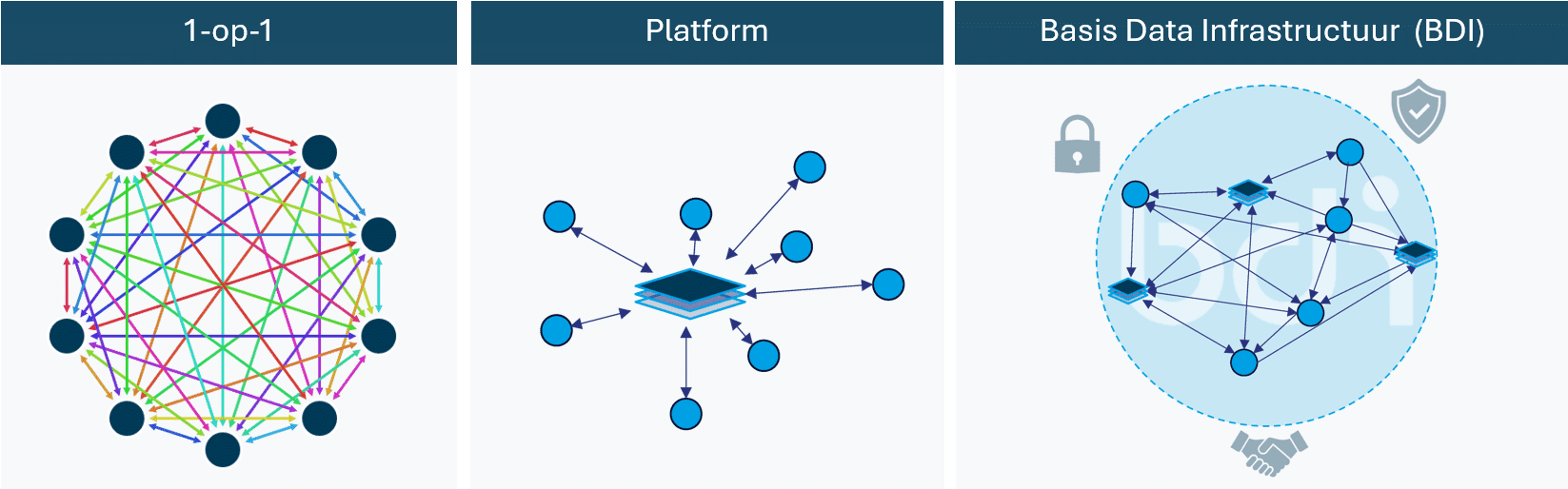
From individual connections to a network
In traditional digital collaboration, individual connections are often built between organisations. As more parties join, the number of connections increases, making the network increasingly complex.
With the BDI, organisations follow the same agreements and principles. This eliminates the need to develop a separate solution for every new collaboration. As a result, data sharing becomes simpler, more flexible and easier to scale.
One framework of agreements, many applications
The BDI is not an application or a database. The framework of agreements ensures that organisations and systems can find, trust and understand each other, while making it clear who is authorised to use which data.
The same foundation can be applied across a wide range of supply chains. For example, to share up-to-date information about containers, improve delivery planning in the construction industry, make CO₂ data available throughout an agrifood supply chain, or exchange reliable information about medicines.
This creates a digital network in which organisations remain independent while collaborating more intelligently, securely and efficiently.