Background and development
Built for collaboration in a digital economy
Supply chains do not stop at the boundaries of a company, industry or country. At the same time, the need for reliable data is growing across areas such as planning, sustainability, compliance, security and AI. The Basic Data Infrastructure (BDI) addresses this need through a Dutch approach to federated data sharing, aligned with broader European and international developments.
Why the Netherlands is embracing federated data sharing
The BDI stems from the Dutch Ministry of Infrastructure and Water Management’s ambition to accelerate the digitalisation of freight transport and logistics chains. Through the Digital Infrastructure for Logistics (DIL) programme, government and industry are working together to establish a common foundation for secure, reliable and standardised data sharing.
The guiding principle is that organisations can collaborate digitally without becoming dependent on a single central authority or platform. Data remains as close to its source as possible, while organisations retain control over how it is used.
From logistics to supply chains
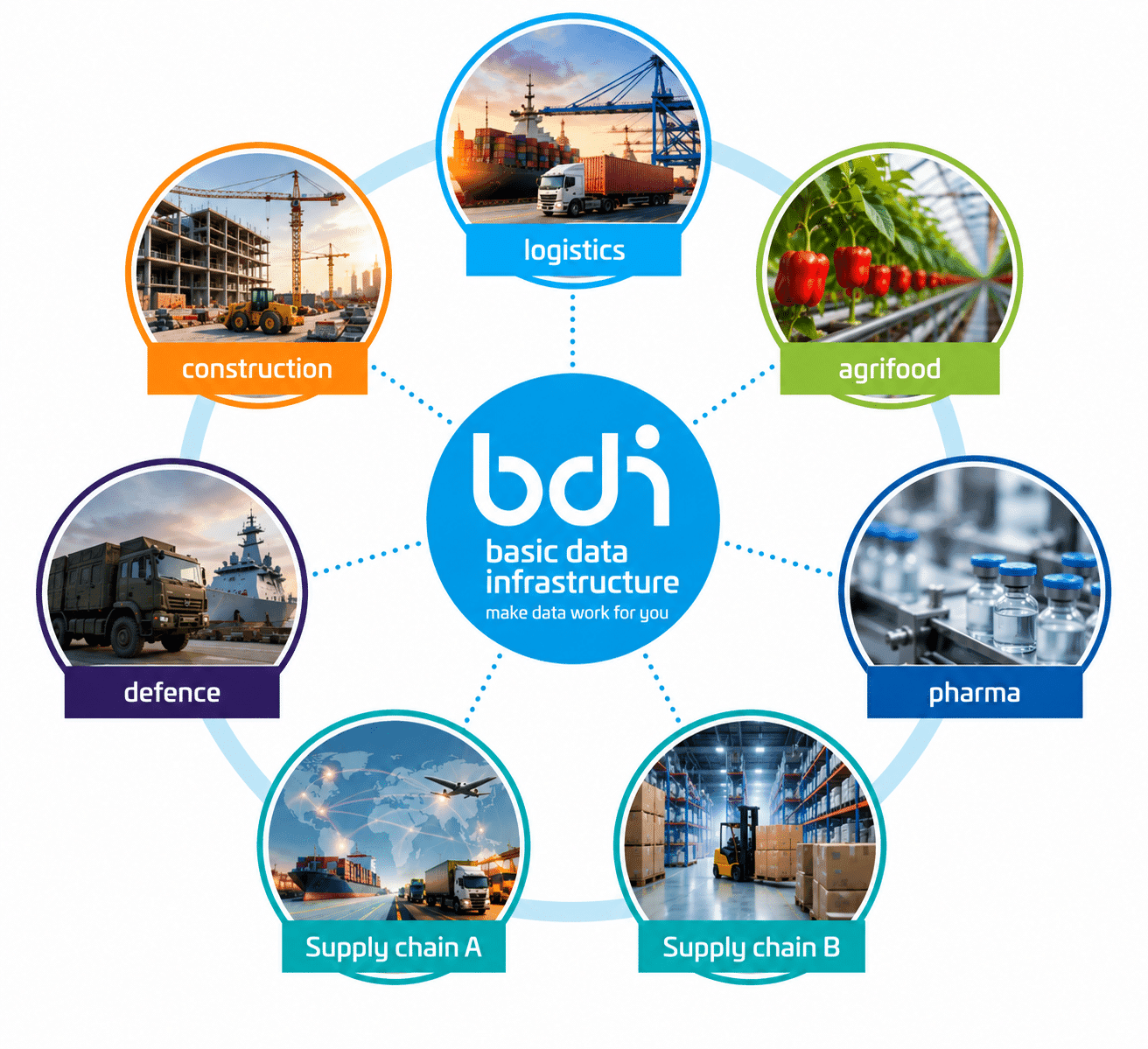
The BDI originated in the logistics sector, where many independent parties rely on up-to-date and reliable information from one another. However, the same challenge exists across other sectors.
Alignment with Europe
Across Europe, too, there is growing attention to data sovereignty, interoperability and federated data sharing. European regulations and initiatives around data spaces are encouraging organisations to share data more easily while retaining control over their own information.
The BDI is aligned with this development. This is particularly important for companies operating in international supply chains: digital collaboration should not stop at national borders, and solutions must be able to align with European frameworks and standards.
Developed in practice
The BDI is not a theoretical model. Its principles, agreements and technical components are being implemented and tested in real-world use cases, together with businesses, government bodies and knowledge institutions.
Practical experience helps further develop the BDI while demonstrating where federated data sharing creates real value. In this way, the BDI evolves step by step alongside the needs of organisations and supply chains.
Curious to see how organisations are already using the BDI to address real-world data challenges?